Most OEM/ODM articles stop at the dictionary definition. This one goes further: what you can actually customize, what each option does to your timeline and unit cost, and how to decide with real numbers on the table.
If you are sourcing LED face masks for your brand, the OEM-vs-ODM question decides three things upfront: how fast you launch, how much you spend before your first sale, and how exclusive your product looks on the shelf.
Here is the practical version — definitions, a decision table, and the lead-time math most suppliers never explain.
Key Takeaway
ODM gets you to market in weeks with the manufacturer’s proven design. OEM builds your own design — slower and costlier, but fully yours. Most successful beauty brands start ODM and graduate to OEM.
The 60-Second Definitions
ODM (Original Design Manufacturing): the manufacturer already designed and tooled the product. You put your brand on it — logo, colors, packaging, sometimes the LED configuration — and sell it as your own line. The molds, patents, and core engineering belong to the manufacturer.
OEM (Original Equipment Manufacturing): you bring the design or the full specification, and the factory engineers and builds it for you — new tooling, new molds, your industrial design. You own the product identity; the factory owns the production problem.
Private label is the term you will hear most often on marketplaces and in Amazon seller circles. In practice it sits on the ODM side of the line: a factory’s existing product, your brand on it. When a supplier says “private label LED mask,” read it as ODM with your branding — and check how deep the customization actually goes.
In LED face masks specifically, the line between the two is blurrier than most articles admit — because a good ODM platform lets you customize far more than a logo. More on that below.
The Decision Table
| ODM (factory design, your brand) | OEM (your design, factory builds) | |
|---|---|---|
| Upfront cost | Low — no tooling fees | High — mold and engineering fees |
| Time to first order | Weeks | Months (design, tooling, validation) |
| MOQ | Low — custom logo from ~100 units | Higher — tooling must amortize |
| Product exclusivity | Shared platform, your branding | Fully exclusive design |
| Technical risk | Low — design already validated | You own the validation burden |
| Best for | New brands, market tests, fast launches | Established brands with R&D budget |
Key Takeaway
If you cannot yet prove your channel sells LED masks, paying tooling fees is a bet, not an investment. Prove demand on ODM first.
What ODM Customization Actually Covers
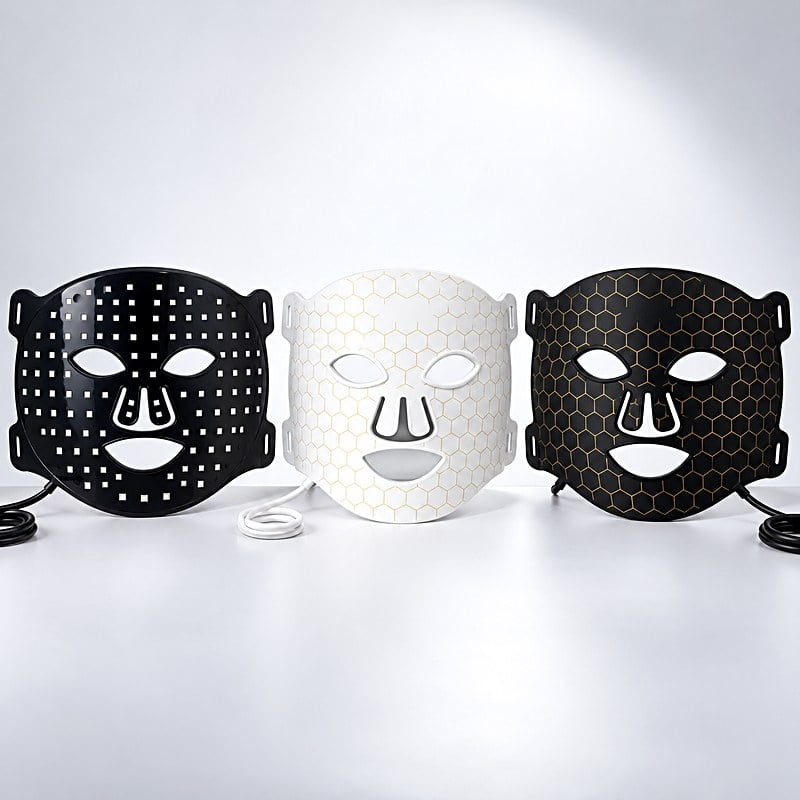
Buyers regularly underestimate how much of an ODM product can be made theirs. On a mature platform, the customizable layer includes:
- Logo and branding: silk-screened logo positions on the mask and controller, placed to your dieline-marked mockup
- Shell color and finish: standard colors from stock; custom colors at volume
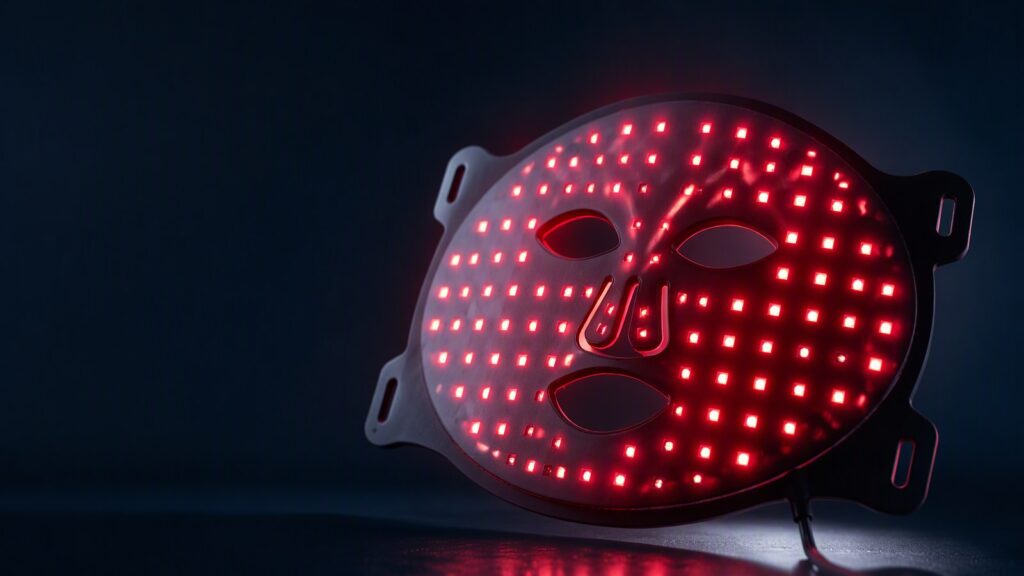
- LED wavelength configuration: this is the one most buyers miss. The LED chips themselves can be swapped — for example, buyers building on published light-therapy literature often specify 660 nm red, 830 nm near-infrared, or 415 nm blue instead of the standard configuration. No new tooling needed; the change happens at the LED level
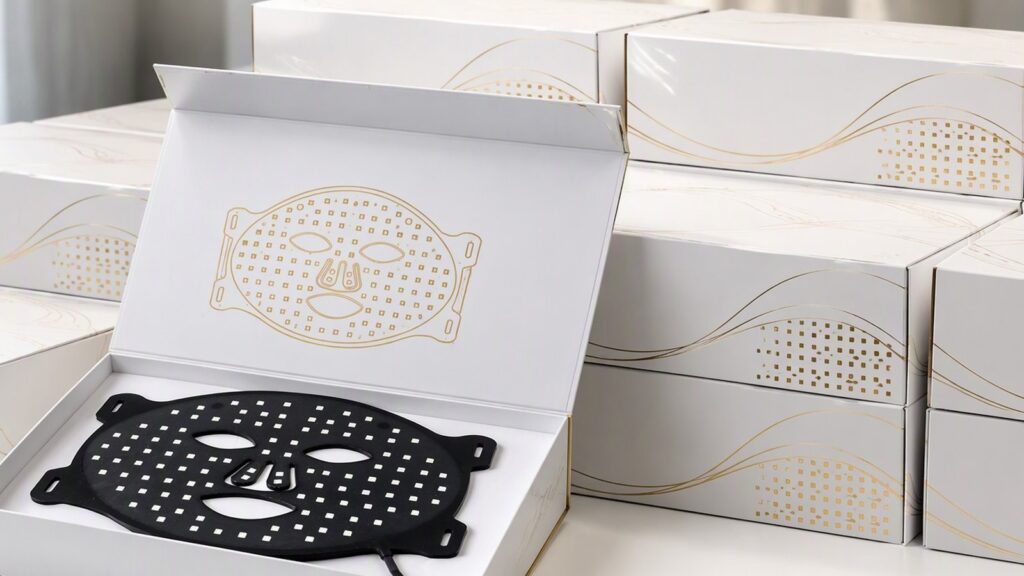
- Packaging: custom printed box from your artwork on the factory’s dielines, with molded tray inserts
- User manual: your language set — multi-language EU versions are a routine ask
- Controller and program: button layout, intensity levels, and treatment timers matched to your product positioning
Key Takeaway
On a good ODM platform, “custom” covers branding, optics, packaging, and documentation. Only the shell shape itself is fixed.
The Lead-Time Math Nobody Explains
“How long?” deserves a structural answer, not a number. Here is how a customized ODM order actually moves:
- Standard samples: about one week, from semi-assembled stock — the fastest way to verify quality before you commit
- Custom-wavelength prototype: if you specify different LED chips (say 660 / 830 / 415 nm), figure about 7 working days to source the chips and assemble sample units — and ask for a spectrometer verification video so the measured values are on record
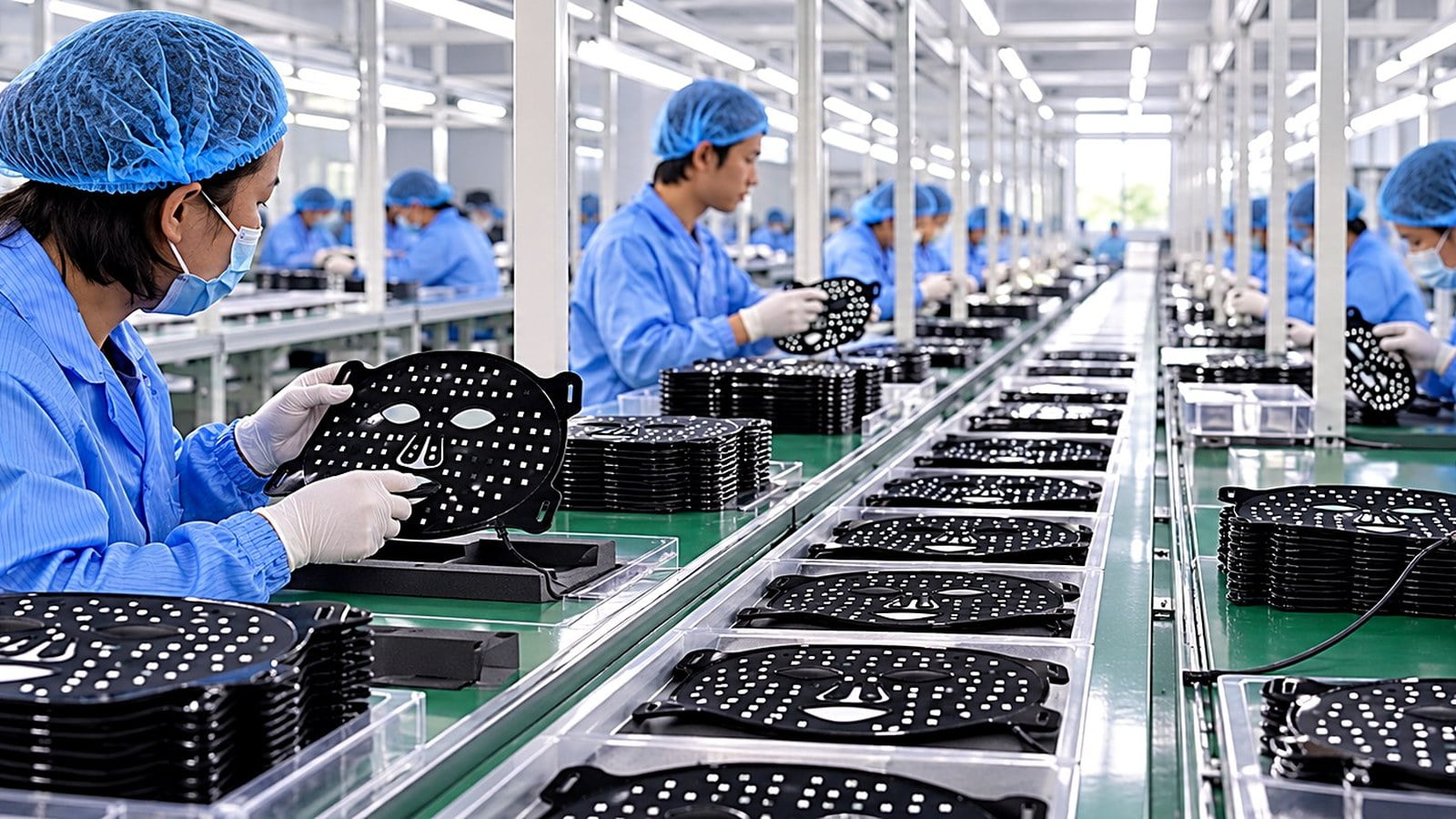
- Bulk production with custom packaging: 20–25 days is the honest figure. Packaging design and confirmation takes 10–15 days, packaging production another 7–10 days — while mask assembly runs in parallel. When the boxes arrive, packed units ship
The mechanism behind speed: manufacturers holding semi-assembled stock trigger final assembly on your order. If a supplier quotes a much longer timeline for a catalog product, ask what they are actually holding in stock. (We covered the full supplier-verification framework in our manufacturer checklist.)
Key Takeaway
Packaging, not production, is usually the critical path on a customized order. Lock your artwork early.
When Full OEM Is Worth It
OEM earns its cost in three situations:
- Your channel demands a unique product: retail buyers and premium DTC brands often cannot list a design that competitors can also source
- You have validated demand: you have sold an ODM version and know the return rate, the price point, and the volume
- You are building a defensible brand asset: your own industrial design, your own patents, a product no one else can list
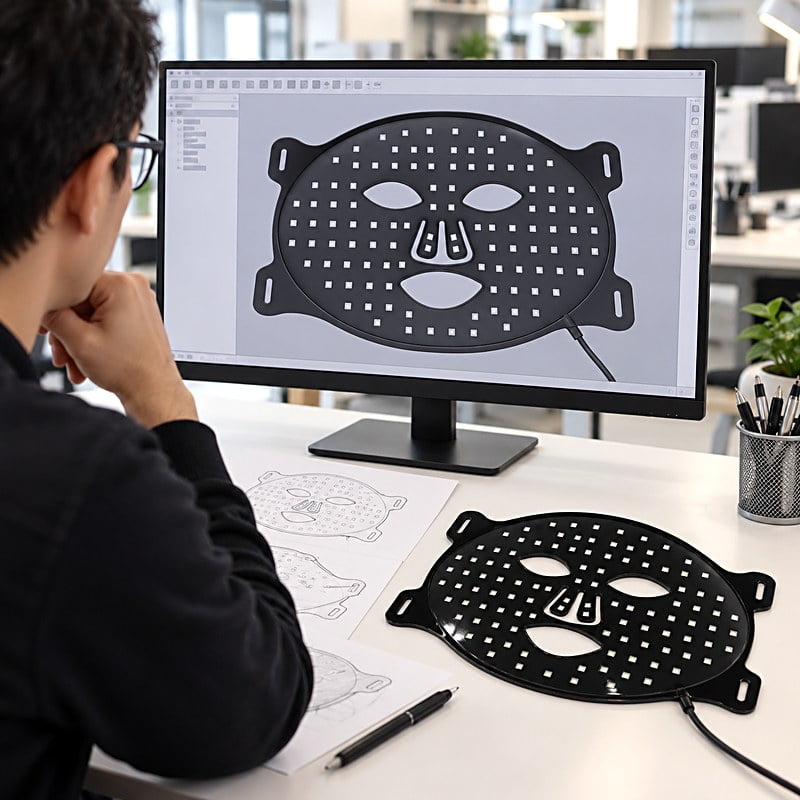
A serious OEM partner starts with an NDA, moves through CAD engineering and tooling, and validates prototypes against your specification before mass production. Expect months, not weeks — and expect the factory to ask hard questions about your volumes, because tooling is their bet too.
The Middle Path Most Brands Actually Take
The pattern we see most often: a brand launches on an ODM platform with their logo, packaging, and LED configuration — sometimes with a custom wavelength set as the differentiator — proves the channel, then invests in OEM tooling for the flagship product once the numbers justify it.
This path caps your downside. Your first order teaches you your return rate, your real price point, and your customer’s actual questions — information no market report gives you — before you commit tooling money.
Five Questions to Ask Before You Choose
- What exactly can I customize on your ODM platform — and what is fixed? (If the answer is “logo only,” the platform is thin.)
- Can you change the LED wavelengths, and how do you verify the result? (Look for measured nanometer values and spectrometer evidence — our wavelength guide shows what real numbers look like.)
- What is the lead time structure — samples, custom prototype, bulk — and what is the critical path?
- What are the MOQs at each customization level — logo, packaging, wavelength, tooling?
- If I start ODM and later go OEM, what does that transition look like — and who owns what?
Key Takeaway
The right model is the one matched to your proof of demand. ODM to learn, OEM to defend.
How We Handle Both
- ODM platform: proprietary molds with 50+ design and utility patents — your product is not on forty other listings
- Customization scope: logo silk-screen, shell colors, custom packaging on factory dielines, multi-language manuals, controller programming
- Custom wavelengths: LED chip swaps to your specification — 660 / 830 / 415 nm and others — with custom prototypes in about 7 working days and spectrometer verification videos
- MOQ: custom logo from 100 units; custom packaging from 500
- Lead times: standard samples ~1 week; bulk 7–15 days standard, 20–25 days with custom packaging
- OEM: NDA-first process, in-house CAD and tooling, prototype validation against your spec
- Compliance: model-matched CE / UKCA / FCC / RoHS documentation plus an IEC 62471 photobiological safety report (RG0 exempt group) with every quotation
See the full scope on our OEM/ODM page, or the engineering and QC behind it on our capabilities page.
Frequently Asked Questions
Is ODM or OEM cheaper for LED face masks?
ODM, almost always — no tooling fees, low MOQs, and samples in about a week. OEM adds mold and engineering costs that only make sense once your volume can amortize them.
Can I customize the LED wavelengths on an ODM product?
On a real ODM platform, yes. Swapping LED chips — for example to 660 nm red, 830 nm near-infrared, or 415 nm blue — changes no tooling. Expect roughly 7 working days for a custom prototype, and ask for a spectrometer verification video with measured values.
Who owns the product design in ODM?
The manufacturer owns the molds and core design; you own your brand assets — logo, packaging artwork, manuals. If shelf exclusivity matters, ask about territory or channel exclusivity terms, or plan the move to OEM tooling.
What MOQ should I expect for full OEM tooling?
Higher than ODM, and negotiated case by case — the factory’s tooling investment has to be covered by your committed volumes. Any factory quoting OEM tooling with no volume questions is not pricing the real risk.