Every LED face mask spec sheet lists wavelengths. Few list measured ones. For a B2B buyer, that gap shapes return rates, review scores, and whether a salon trusts your device.
This guide breaks down the five wavelengths used in LED face masks, from 465 nm blue to 1072 nm near-infrared. You will see what each one is positioned for, which packages sell in each channel, and four questions that separate verified suppliers from catalog resellers.
Key Takeaway
A wavelength claim without a measured nanometer value is a marketing claim. Buy the number, not the adjective.
The Five Wavelengths, in One Table
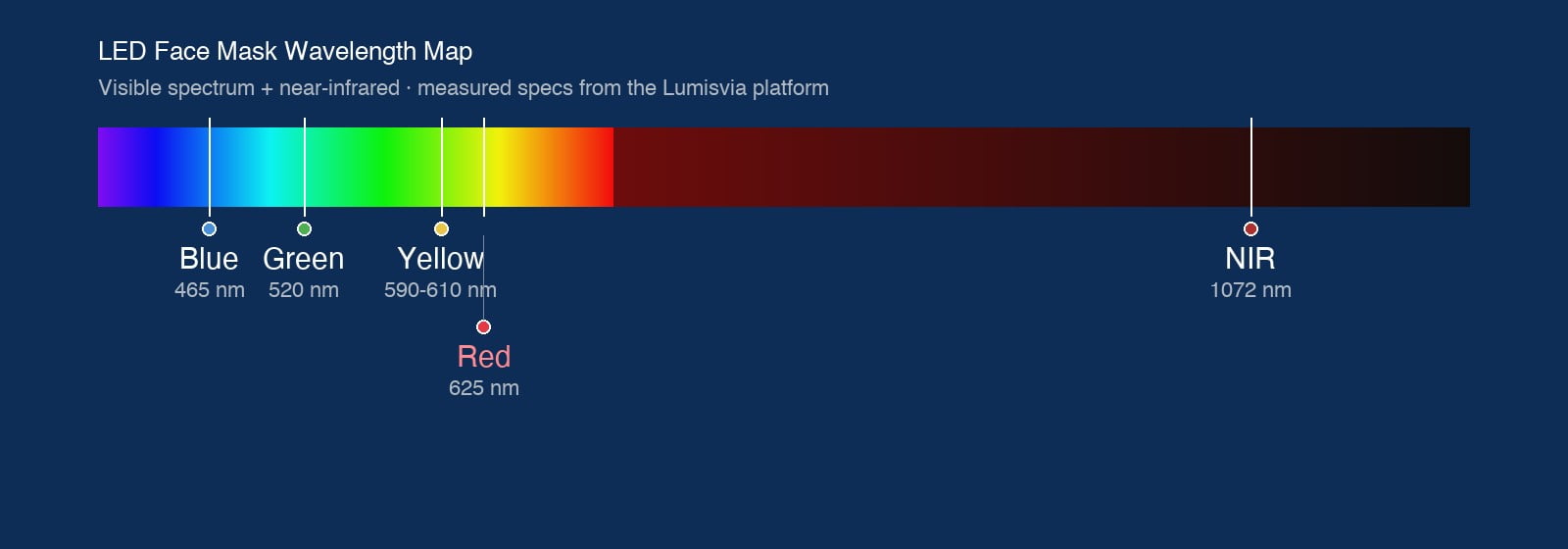
Here is the full picture on one page: common industry ranges next to the values our platform is built on. Output runs at 15–45 mW/cm², adjustable across 3 intensity levels.
| Wavelength | Common Range | Our Spec | Skin Depth | Retail Positioning |
|---|---|---|---|---|
| 🔵 Blue | 415–470 nm | 465 nm | Epidermis | Oil control, blemish-prone skin |
| 🟢 Green | 520–570 nm | 520 nm | Epidermis | Tone evening, dullness |
| 🟡 Yellow | 590–610 nm | 590–610 nm | Upper dermis | Redness relief, sensitive skin |
| 🔴 Red | 620–660 nm | 625 nm | Dermis | Anti-aging, skin repair |
| ⚫ Near-Infrared (NIR) | 830–1200 nm | 1072 nm (optional) | Subcutaneous | Deep repair, firming |
Key Takeaway
Red and blue are the volume sellers. NIR is where premium margins live.
What Each Wavelength Means for Your Product Line
Blue (465 nm): The Acne Channel Staple
Blue light at 465 nm works at the skin surface. It is positioned for oil control and blemish-prone skin, a large search category in acne-focused channels. Pair it with red so one device covers two concerns.
Retail angle: blue + red is the minimum combo for marketplace listings.
Green (520 nm) & Yellow (590–610 nm): The Sensitive-Skin Upsell
Green and yellow sit in the epidermis and upper dermis. They are positioned for tone evening, dullness, and redness-prone sensitive skin. On an RGB platform, these modes are inexpensive to include.
Retail angle: mode count moves units at retail, so more modes on the box earn their place.
Red (625 nm): The Core Seller
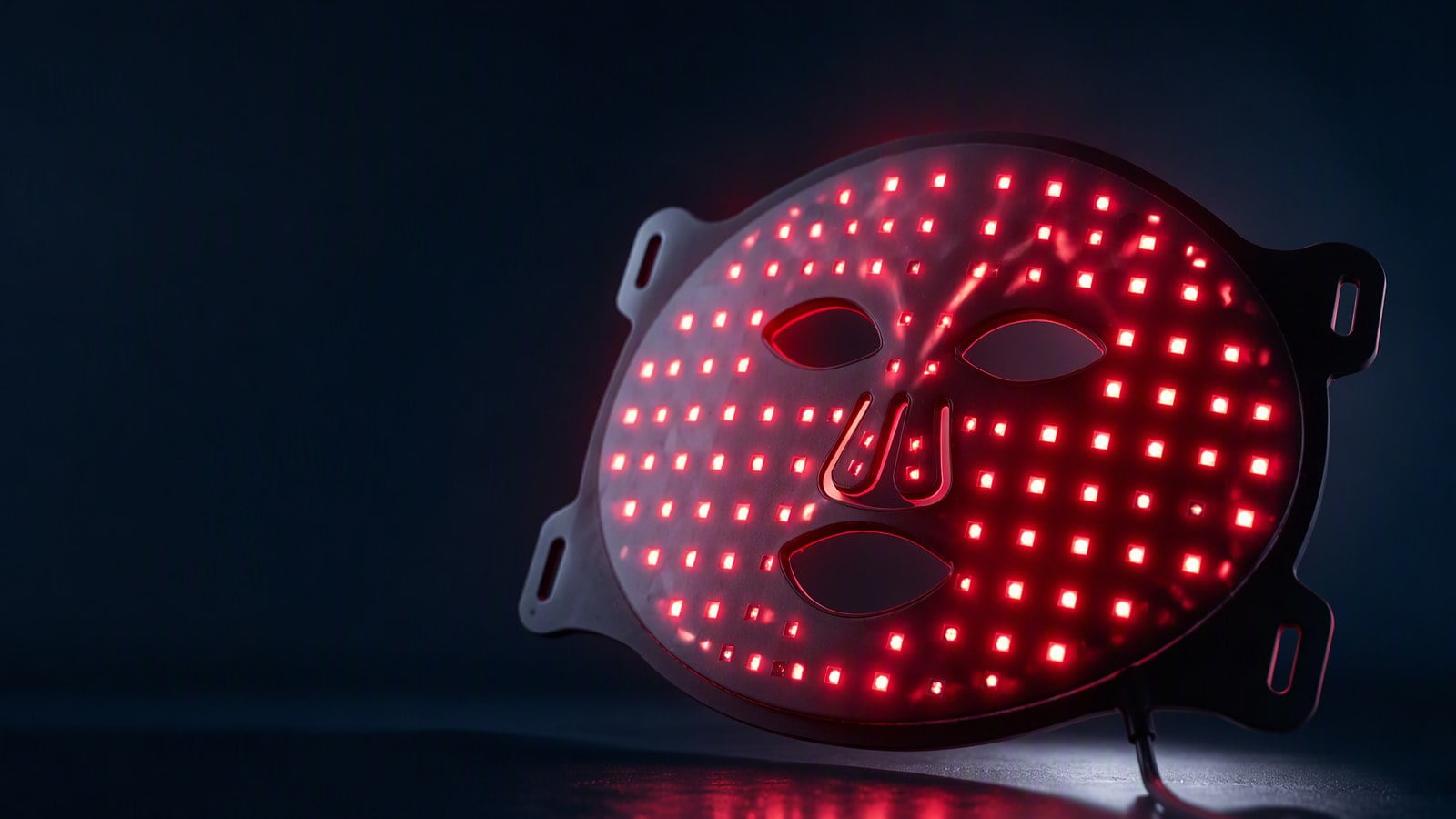
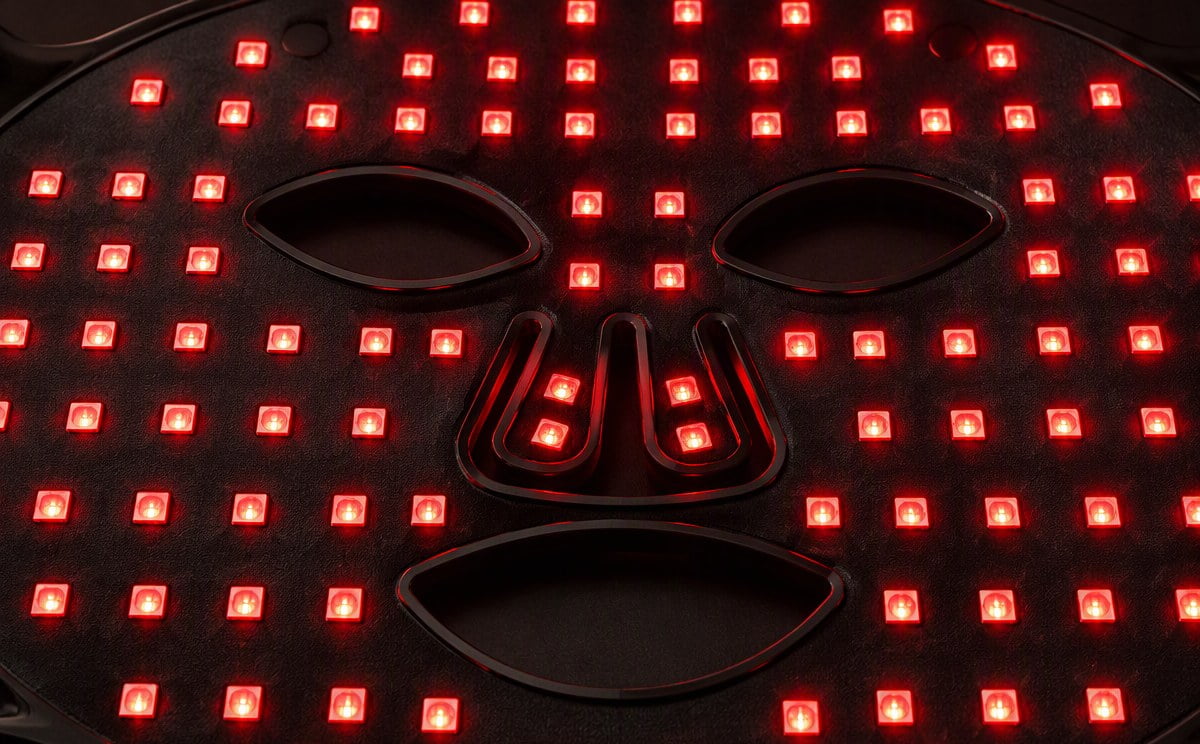
Red light reaches into the dermis and anchors anti-aging positioning. It is the wavelength most often associated with supporting collagen production. Our platform runs 625 nm, inside the 620–660 nm window, measured with an in-house spectrometer.
Retail angle: lead your listing with red; it is the mode buyers look for first.
Near-Infrared (1072 nm): The Premium Tier
Near-infrared sits outside the visible range and reaches the deepest layers. It is positioned for deep repair and firming in premium SKUs and salon channels. On our platform, 1072 nm NIR is an optional, model-dependent upgrade.
Retail angle: NIR supports a higher shelf price, when your channel can carry it.
Key Takeaway
Standard 7-mode RGB covers the volume market. Add 1072 nm NIR when your channel supports a premium price.
Which Combinations Sell, by Channel
The right wavelength package depends on where the mask will sell and at what margin.
- Marketplace sellers: 7-mode RGB wins on price. Mode count drives clicks; keep the unit price competitive.
- Beauty brands: 7-mode RGB plus NIR as the flagship. One premium SKU lifts the whole line.
- Salons and clinics: red + NIR, with measured data on file. IP63-rated sealing stands up to daily wipe-downs between clients.
- Distributors: face + Neck & Décolleté combo sets raise average order value. One controller ecosystem, one shipment.
Key Takeaway
Match the wavelength package to the channel margin, not to what sounds impressive.
OEM · ODM · Private Label
Spec your OEM order with measured data.
Tell us your target channel and quantity — we reply within 24 hours with specs, tiered pricing, and sample options.
Four Questions to Ask Any Supplier
Use these on every quote request. A supplier with real data answers all four in writing.
01. What is the exact nanometer value of each mode?
A range like “red 620–660 nm” hides which chip you actually get. Ask for one measured number per mode.
02. Is output measured per batch, in mW/cm²?
Irradiance can drift between LED batches. Our platform is specified at 15–45 mW/cm² adjustable output across 3 intensity levels.
03. Will the data arrive in writing with the quotation?
Verbal claims do not survive a retail audit. Ask for model-matched data plus CE / FCC / RoHS / UKCA documentation in the quote package.
04. What does NIR really add to the unit price?
Some suppliers list NIR as a feature, then quote it as an add-on. Ask for pricing with and without NIR, side by side.
The Bottom Line
Wavelengths are not a feature list. They are a positioning decision. Red and blue carry the volume market, green and yellow add shelf appeal, and NIR opens premium tiers.
Whatever package you choose, buy measured values, not adjectives. Ask for nanometers per mode and output in mW/cm², in writing. Every Lumisvia mask ships with model-matched wavelength and irradiance data in the quotation package.
Frequently Asked Questions
What is the best wavelength for an LED face mask?
There is no single best wavelength. Red (625 nm) is the core seller for anti-aging positioning. Blue (465 nm) is designed for blemish-prone skin. Near-infrared (1072 nm) supports premium tiers. Most buyers start with 7-mode RGB and add NIR for flagship SKUs.
Is 625 nm red light effective?
625 nm sits inside the 620–660 nm red window most often cited for supporting collagen production. For a buyer, the key point is that the value is measured, not estimated. Our 625 nm value is measured in-house with a spectrometer and shared in writing with every quotation.
Do I need near-infrared in my LED mask?
Only if your channel supports a premium price. Standard 7-mode RGB covers the volume market. 1072 nm NIR is an optional, model-dependent upgrade on our platform, positioned for premium SKUs and salon channels.
How do I verify a supplier’s wavelength claims?
Ask for the exact nanometer value per mode, output in mW/cm², and both in writing with the quotation. Then request samples to check against the data. Lumisvia includes model-matched wavelength and irradiance data plus CE / FCC / RoHS / UKCA documentation in every quotation package.
Measured Data · Tiered Pricing · Samples
Start With the Numbers.
Tell us your target channel and quantity — we reply within 24 hours with specs, tiered pricing, and sample options.