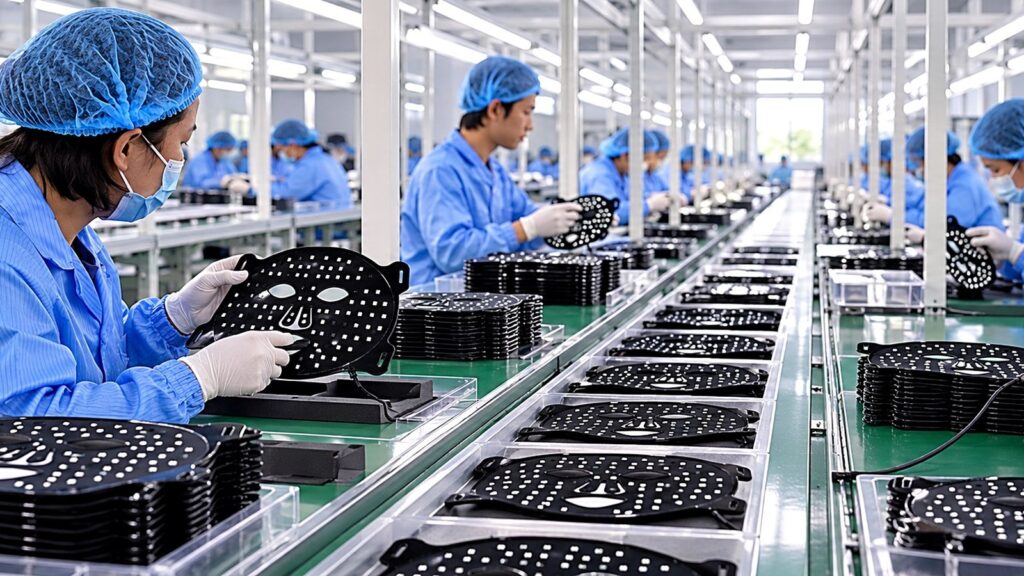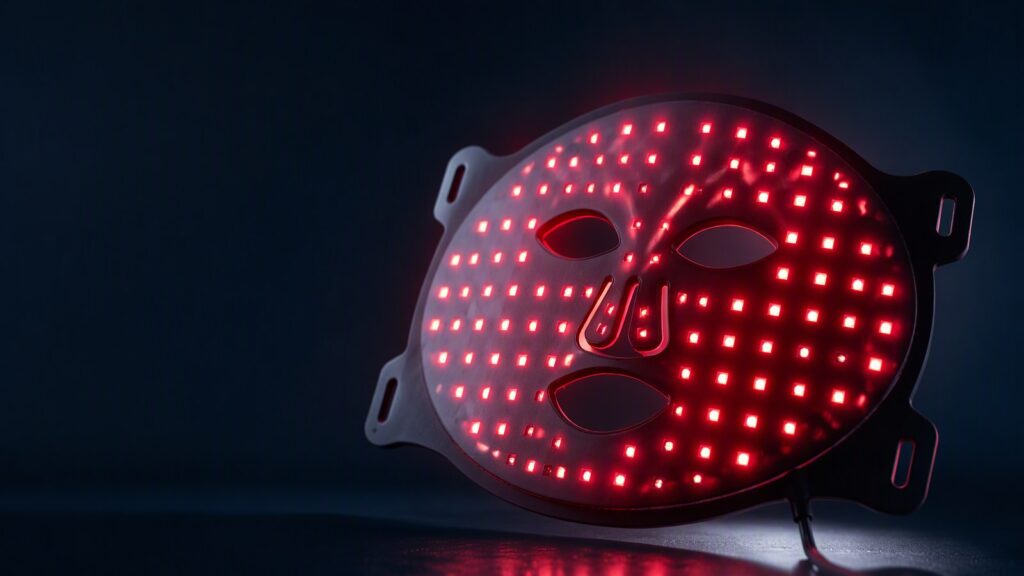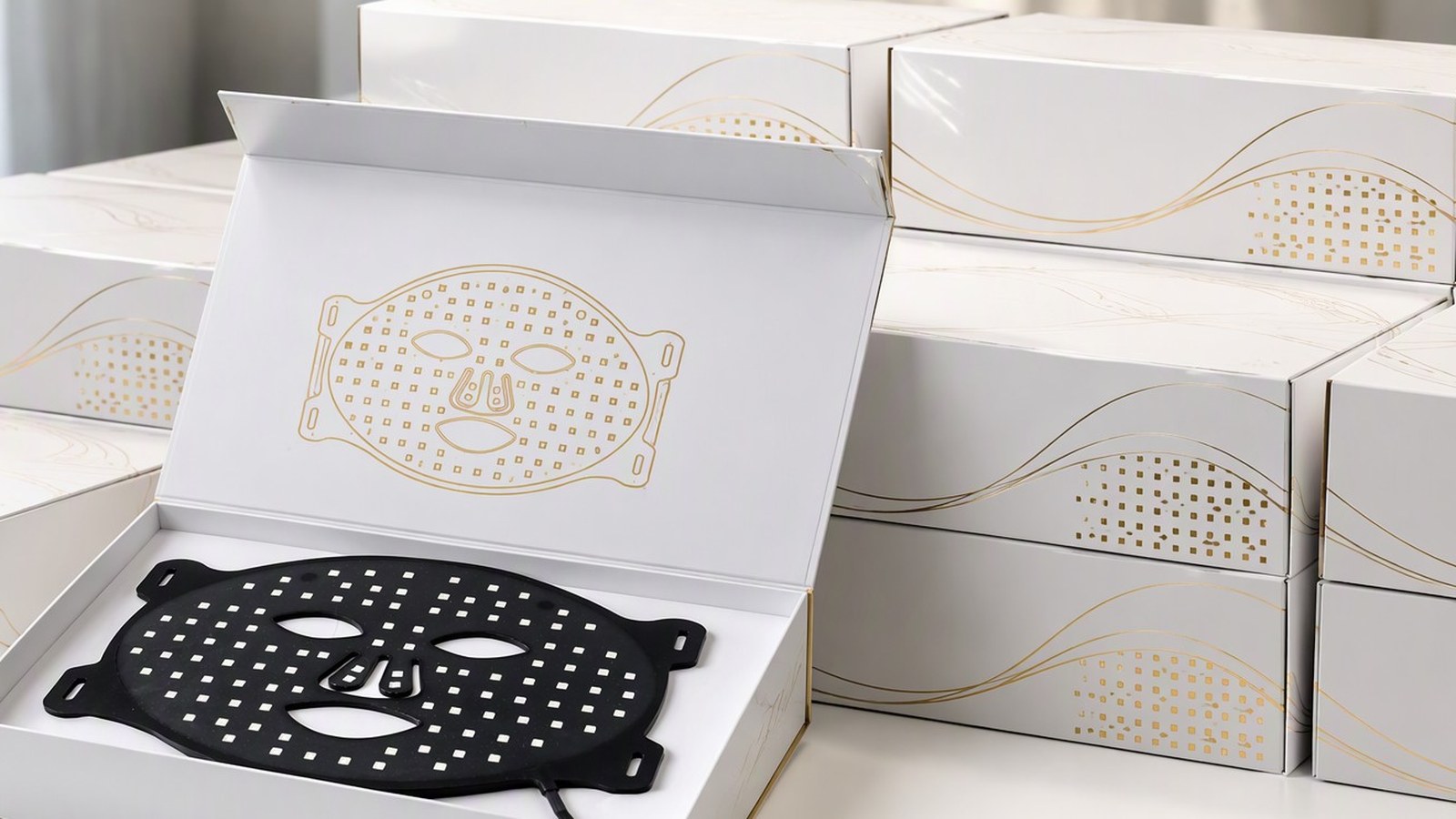
MOQ is the first wall most new beauty brands hit. It is also, handled well, your best risk-management tool: a 100-unit first order is not a compromise — it is a market test with a tuition fee you can afford.
If you are launching an LED face mask line, the question is not “how cheap can I buy 1,000 units.” It is “how little do I need to spend to learn whether my channel actually sells this product.” This guide answers that with real numbers: what each MOQ tier buys you, what it costs you, and how a first order should be structured.
Key Takeaway
Treat your first order as paid market research. The goal is sell-through data and customer questions — not margin.
Why MOQs Exist (the Honest Version)
Every factory’s MOQ comes from three physical constraints:
- Material batches. Silicone, LED chips, and batteries are purchased in supplier minimum lots. Small orders ride on material already in stock.
- Line setup. Switching an assembly line to your configuration costs setup time whether you order 50 or 5,000 units — which is why unit prices step down at volume tiers.
- Print runs. Custom packaging is a printing job. Box printers have their own minimum runs, which is why custom packaging usually starts hundreds of units above custom logo.
A supplier who explains their MOQ in these terms is showing you their cost structure. A supplier who just says “MOQ 1,000” with no mechanism is either a trader adding a buffer — or a factory that does not hold the stock they claim.
Key Takeaway
MOQ is not a gatekeeper’s whim. It is a map of the factory’s material and setup costs — ask to see the map.
What Each MOQ Tier Actually Buys
| Order size | What you can customize | What you cannot (yet) |
|---|---|---|
| ~100 units | Logo silk-screen on mask and controller, stock shell colors, standard box with your insert card | Custom printed packaging, custom wavelengths |
| ~500 units | Everything above, plus custom printed packaging from your artwork, LED wavelength swaps (e.g. 660 / 830 / 415 nm) | Custom shell shape |
| Tooling tier (OEM) | Your own industrial design, new molds, full exclusivity | — |
The jump from 100 to 500 units is mostly about the box. The jump from ODM to OEM tooling is a different business decision entirely — we broke that down in OEM vs ODM vs Private Label.
Key Takeaway
Know which tier buys the customization you actually need. Many brands pay for 500 units when 100 would have answered their real question.
The 100-Unit Market Test Playbook
Here is the structure we see working for first-time buyers:
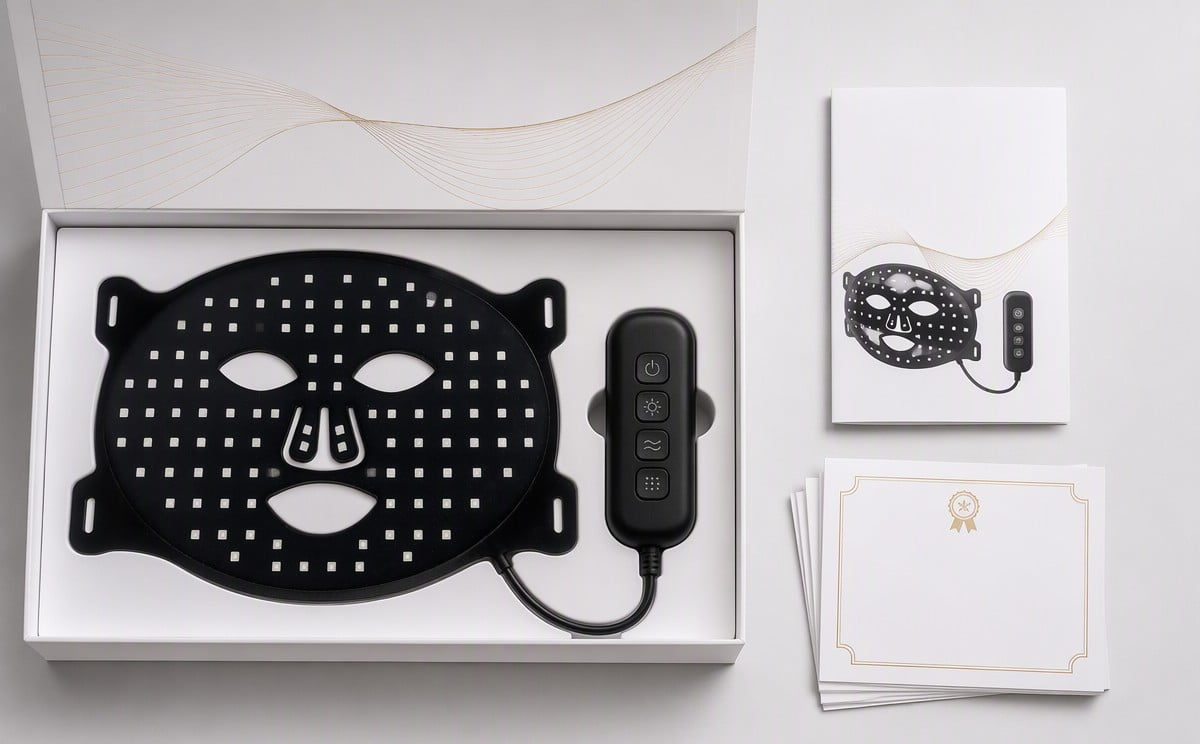
Step 1 — Verify before you commit. Order a sample kit first. Ours is US$150 for two combo sets, credited back against your bulk order — so verification costs you nothing if you proceed. Add a video walkthrough of the production line if you want to see the operation before that.
Step 2 — Order 100 units with your logo. Stock colors, standard packaging, your branding. Standard lead time is 7–15 days because core models are held semi-assembled and finished on order.
Step 3 — Sell and measure everything. Sell-through rate, return reasons, the exact questions customers ask. This is the data no market report can give you.
Step 4 — Scale what the data supports. If the channel works, step up to 500+ with custom packaging, or spec custom wavelengths as your differentiator. If it does not, your tuition was 100 units, not 1,000.
One more layer of protection: ask about the defect policy before you order. Ours is simple — send a short video of any affected units and replacements ship with your next order.
Key Takeaway
Samples → 100 units → data → scale. Each step has an exit, and the exits are what make the test cheap.
How Low MOQ Is Even Possible
Low MOQ with a 7–15 day lead time sounds contradictory until you see the mechanism: semi-assembled stock.
The silicone shells, circuit boards, and controllers are produced and partially assembled in advance. Your order triggers final assembly, logo printing, and packing. The factory carries the inventory risk on generic components; you carry none on finished goods.
This is also the answer to a fair skepticism: if a supplier offers “no MOQ at all,” ask what they are holding. True no-MOQ usually means a trader ordering from a factory after you pay — adding margin and lead time while removing your visibility into production. Our manufacturer checklist covers ten ways to tell the difference.
Key Takeaway
Real low MOQ is built on semi-assembled inventory. Fake low MOQ is a trader’s relay. Ask which one you are looking at.
Three Red Flags Around MOQ
- “No MOQ” with no factory floor. No stock mechanism means someone else holds the risk — usually you, later, in lead time.
- MOQ 1,000+ with no sample path. A factory confident in its product sells samples first. Refusing samples at scale-MOQ pricing is a tell.
- MOQ that hides tooling fees. Occasionally a “low MOQ” quote quietly includes mold or setup charges. Ask for the all-in number at 100, 500, and 1,000 units, side by side.
Five Questions to Ask Any Supplier About MOQ
- What exactly is customizable at your lowest MOQ — and what tier unlocks the next customization?
- What does the unit price do at 100, 500, and 1,000 units? (Get all three in writing.)
- Can I order samples first, and is the sample cost credited against my bulk order?
- What mechanism makes your MOQ possible — what are you holding in stock?
- What happens if units arrive defective on my first order?
How We Handle It
- Custom logo: from 100 units
- Custom packaging: from 500 units, on factory dielines
- Sample kit: US$150 for two combo sets, credited to your bulk order; standard samples ship in about a week
- Lead time: 7–15 days standard; 20–25 days with custom packaging (packaging design runs 10–15 days, production 7–10, assembly in parallel)
- Custom wavelengths: available at volume tiers, with spectrometer verification videos
- Defects: video claim, replacements with your next order
- Compliance: model-matched CE / UKCA / FCC / RoHS plus IEC 62471 RG0 report in every quotation package
Full pricing and the sample request form are on our wholesale page.
Frequently Asked Questions
Is 100 units really enough to launch a brand?
It is enough to answer the only question that matters at this stage: does your channel sell this product? A 100-unit order with your logo gives you sellable inventory, real customer feedback, and return-rate data — the inputs for a defensible scale-up decision.
Does a low MOQ mean a much higher unit price?
Higher, not “much” higher — and the difference is the cost of information. Unit prices step down at 500 and 1,000 units because setup costs amortize. Ask for the full price ladder before you decide which tier is actually expensive.
Can I get custom packaging at 100 units?
Technically possible, rarely sensible. Box printing has its own minimum runs, so custom packaging at 100 units adds disproportionate cost per unit. Most brands run standard packaging at 100 and move to custom boxes at 500 — which is exactly the tier structure we quote.
How do I check quality before ordering 100 units?
Order the sample kit and put it through your own routine: charge cycles, output feel, controller logic, packaging. If you want more, ask for a live video walkthrough of the production line and aging racks — a real manufacturer shows the floor.